
Covina Previous Residents: Era Sources
A Covina previous-residents search works best as a sequence of record types. Deeds establish legal transfers, while directories and census schedules add household clues. Permits can date physical change, and probate or obituaries can explain why an owner or family disappears. Each source has a different custodian and a different idea of what an address means.
| Source | Years It Covers | Where Held | What It Shows |
|---|---|---|---|
| RR/CC recorded real-estate records | 1850-present | Norwalk RR/CC; known-copy orders | Owner transfers, parties, and legal parcel chain |
| Covina city directories | 1947, 1949, 1950; regional 1955 | Cataloged genealogy collections | Resident, spouse, occupation, and address clues |
| GTE Covina address directory | September 1989 | LA County Library Californiana, Norwalk | Street and house number to listed subscriber |
| Regional telephone directories | 1990-1993 and 2000-2007 examples | LA County Library Californiana | Listed subscriber and business continuity |
| Federal census | 1900-1950 | NARA and library databases | Household relationships, tenure, and occupation |
| City building permits | Exact start not published; searchable archive | Covina Laserfiche and Building & Safety | Work, dates, applicant, and contractor |
| Probate, obituaries, and newspapers | Dates vary | LA Superior Court, library, and historical society | Death, heirs, prior addresses, and community ties |
Match the era: current parcels need assessor-to-recorder; mid-century households need directories and the 1950 census; older houses may need county records, maps, newspapers, and probate.
Note: Directory years are verified leads, not a complete Covina run; confirm the physical volume, title, and coverage with the holding institution.
Covina Previous Residents and the AIN
The Los Angeles County Assessor is the first stop for a current Covina address because its public portal supports address and Assessor Identification Number searches. An AIN is the county's parcel connector, commonly displayed as three number groups in a four-three-three pattern. Save the AIN, situs address, legal description, map reference, current assessed owner when displayed, and the mailing address distinction before moving to the deed records.
Use the Los Angeles County Assessor Portal by address or AIN, and review the assessor property-search guidance for the parcel workflow. A situs address is the physical location. A mailing address is where assessment mail goes and may be elsewhere. Neither field proves who lives at the property, and protected-person information or ownership entities can limit what appears.
- Situs address
- The physical parcel location used to connect a modern address with an assessment record.
- AIN
- The Los Angeles County parcel identifier used to keep map, assessment, and legal-description clues together.
- Assessed owner
- The party shown in the assessment record when public, not a complete list of people who occupy the parcel.
Trace Covina Past Owners Through Deeds
Los Angeles County RR/CC keeps recorded real-estate records from 1850 to the present, but indexes by grantor, grantee, and recording year, not address or APN. The current assessed owner is a starting name. Search it as grantee near the likely acquisition year, read the deed, then carry the seller backward.
- Resolve the address in the assessor portal and save the AIN, legal description, current assessed owner, and mailing-versus-situs distinction.
- At the Norwalk index, search the current owner as grantee in a plausible recording-year range and identify the acquisition document.
- Read the deed for the grantor, document number, recording date, and legal description, then verify the parcel identity.
- Search that grantor as an earlier grantee and repeat the same comparison for every transfer.
- Use a known document number for a copy order when possible, rather than paying for repeated exploratory searches.
Viewing is available at Real Estate Records, 12400 Imperial Highway, Room 2207, Norwalk, California 90650, Monday through Friday from 8 a.m. to 5 p.m., except holidays. The county lists telephone help at (800) 201-8999, option 3. Known documents can be ordered in person, by mail to the Real Estate Records Section, P.O. Box 1130, Norwalk, California 90651-1130, or online through the county's linked payment service. Online orders are stated to process within 20 working days.
The RR/CC real-estate records request page gives the official ordering route before a visit.
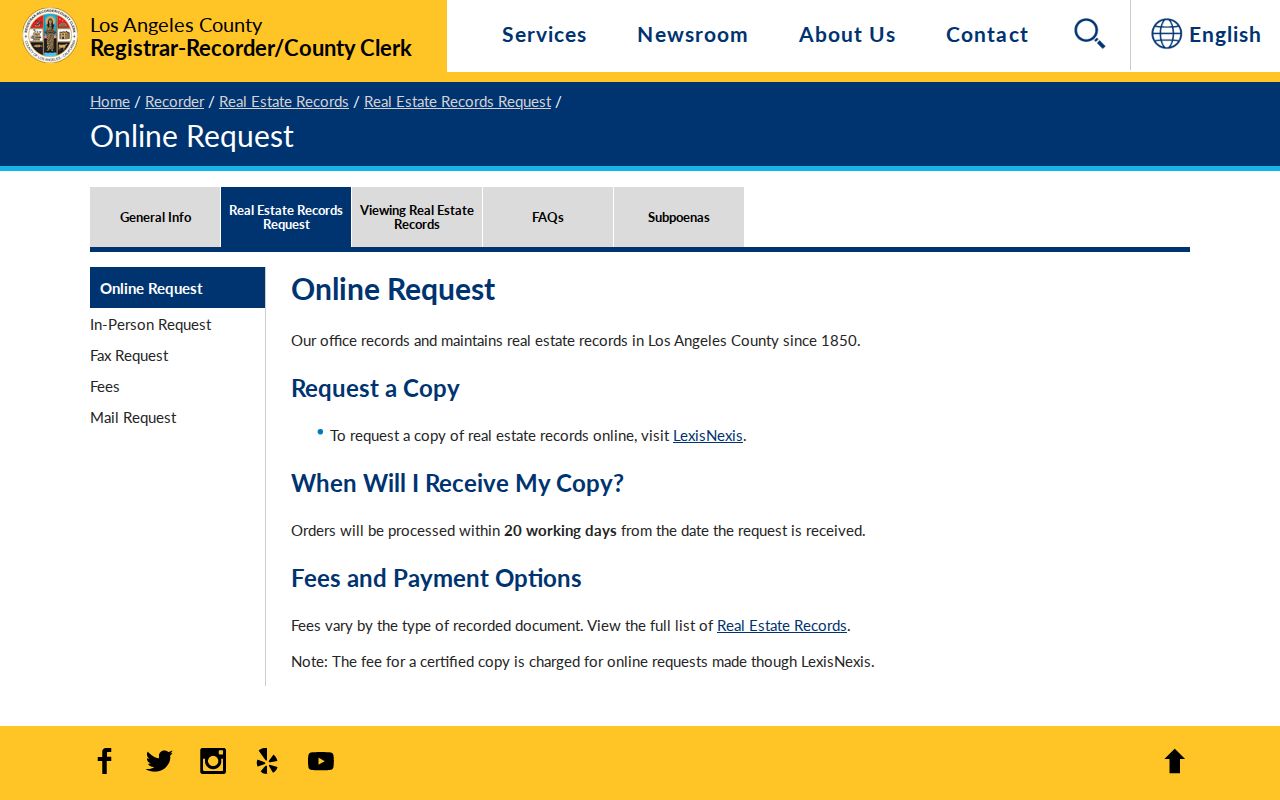
The recorder-request image sits beside the access details: plain copies are $5 for the first page and $3 for each additional page; certified copies are $6 for the first and $3 for each additional.
Covina Address Legal Descriptions
Street text can change while the land identity remains recognizable. A deed's legal description may use a tract, lot, and block, or another recorded parcel description. Compare that language with the AIN, parcel map, subdivision reference, and return address. A similar surname or a nearby street is not enough to prove that two deeds concern the same place.
- Grantor
- The party transferring an interest, usually the seller or person conveying title in the recorded instrument.
- Grantee
- The party receiving an interest, usually the buyer or successor named in the recorded instrument.
- Chain of title
- The linked sequence of recorded transfers from one owner to the next for the same legal parcel.
- Legal description
- The recorded land identity, such as tract, lot, and block, that can outlast a street name or house number.
Legal-description continuity also helps with subdivisions, lot mergers, and successor AINs. Keep a note of every variant instead of flattening the chain into one modern address. The recorder's index can show a transfer, but it does not show every person who occupied the property, and the assessor roll is not a household roster.
Covina Households Across Directory Years
Previous residents are often household clues rather than title parties. The 1947, 1949, and 1950 Covina directory leads, together with the regional 1955 volume, can place a name at an address. The 1950 census adds relationships, ages, birthplaces, occupations, tenure, and household order. The Covina city directory collections provide the shelf and edition context; the backward trail uses only the entry needed for the selected address.
- Transcribe the directory name, spouse, initials, street, number, telephone, and publisher marks exactly.
- Check the 1950 census for the same name and address, then compare household relationships, age, birthplace, tenure, and occupation.
- Compare a prior or later directory lead to establish a cautious “listed by” or “listed through” range.
- Test a move, death, or inheritance with a newspaper, obituary, probate file, permit, or successor deed.
A directory disappearance may reflect a move, death, non-listing, telephone-service change, or publication lag. The 1960 census remains closed until 2032 under the 72-year rule, so the 1955 directory and later regional books must be bridged with deeds, permits, newspapers, and vital or probate records.
1989 GTE and Covina Previous Residents
The September 1989 GTE Covina and nearby cities address directory answers the reverse question: who was listed at a street and house number? It is different from an alphabetical directory, which starts with a name. Use the address section to record the subscriber, telephone, neighboring numbers, and title wording, then compare those clues with the AIN and deed chain.
Californiana also lists Pomona-area address-directory examples from 1990 through 1993 and San Gabriel Valley East white and yellow page examples from 2000 through 2007. Regional-title drift can hide Covina coverage, so check each edition for its city and service area.
Note: A GTE listing identifies a dated subscriber when present; it does not prove every household member lived at the address or that an unlisted household was absent.
The Californiana directory inventory is the best verified title-finding aid for this regional shelf.
Covina Past Residents: Permits and Probate
Covina's public-records archive describes building permits searchable by street address, but exact permit coverage is not published and Laserfiche is undergoing maintenance and adjustments. Ask for an identifiable permit or planning record if it is not posted. Recent rezoning and general-plan alignment packets also publish maps and assessor-parcel lists, including Phase 1 effective July 3, 2025, and Phase 2 proceedings into March 2026. They document affected land, not occupants.
Probate and obituaries can explain the end of an ownership trail. Search LA Superior Court CourtConnect for an index clue, then use a courthouse kiosk or clerk copies for filed papers. A probate case may name a decedent, representative, or heirs. An obituary can connect a former address to relatives or a service. A successor deed remains the ownership evidence, and death records have separate access rules.
For the county death-record channel, use the Los Angeles County RR/CC death records page. It is safer to verify a death with the custodian than to infer it from a missing directory line.
For related family-history events, the county's birth-records page and marriage-records page separate those requests. California's vital-record fee schedule lists 2026 amounts, while its authorized-versus-informational guidance explains why copy type and requester eligibility matter.
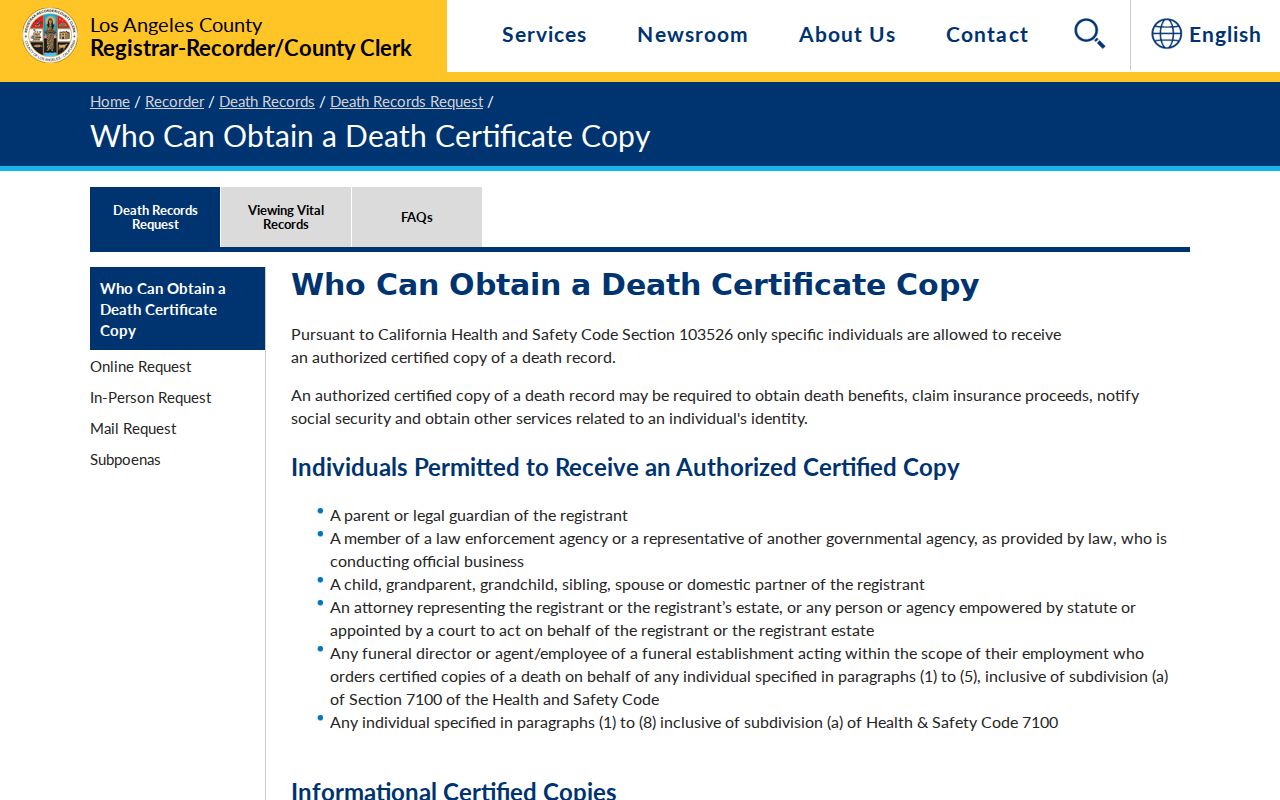
The death-record image marks the point where an obituary clue should be checked against an official county record and its access rules.
Changing Addresses for Covina Previous Residents
Covina's older land story runs through Rancho La Puente. Joseph Swift Phillips bought about 2,000 acres in 1881, Fred Eaton laid out ten-acre lots, the town was founded in 1886, and incorporation followed in 1901. County land records therefore precede city permits. An address can outlive a resident, while a parcel can outlive an address. Research did not verify a citywide Covina street-renumbering year or one year for every renaming or subdivision event. Keep that gap explicit. Bridge old and new labels with the AIN, tract, lot, block, cross streets, permit plans, old map indexes, and the legal description.
Sanborn fire-insurance maps may help with building footprint and site use, but no Covina-specific edition year was verified. The Library of Congress Sanborn search guide can test a map lead without turning an unverified date into a fact. A map does not identify all occupants.
Subdivisions and lot mergers create successor AINs. Capture each separately, compare official parcel geometry, and preserve older legal descriptions so the trail survives a changed street number.
Covina Previous Residents and AB 987
Covina's AB 987 covenant database offers a rare bridge from an address to a recorder document number. Entries can include a street address, AIN, unit count, construction or rehabilitation year, covenant document number and date, and restriction expiration. Examples in the research include Village Green at 152 E. Covina Boulevard, Covina Gardens at 200 W. Rowland Street, and Cienega Gardens at 1211 N. Lyman Avenue.
Use a published covenant number to order the exact RR/CC record, then compare the document's legal description and parties with the parcel chain. The database is not a resident roster. It documents a recorded covenant and project history, which can make a known-document request more precise when the recorder does not accept an address as its index key.
The RR/CC recorder fees page gives the current schedule for planning a copy or recording request.
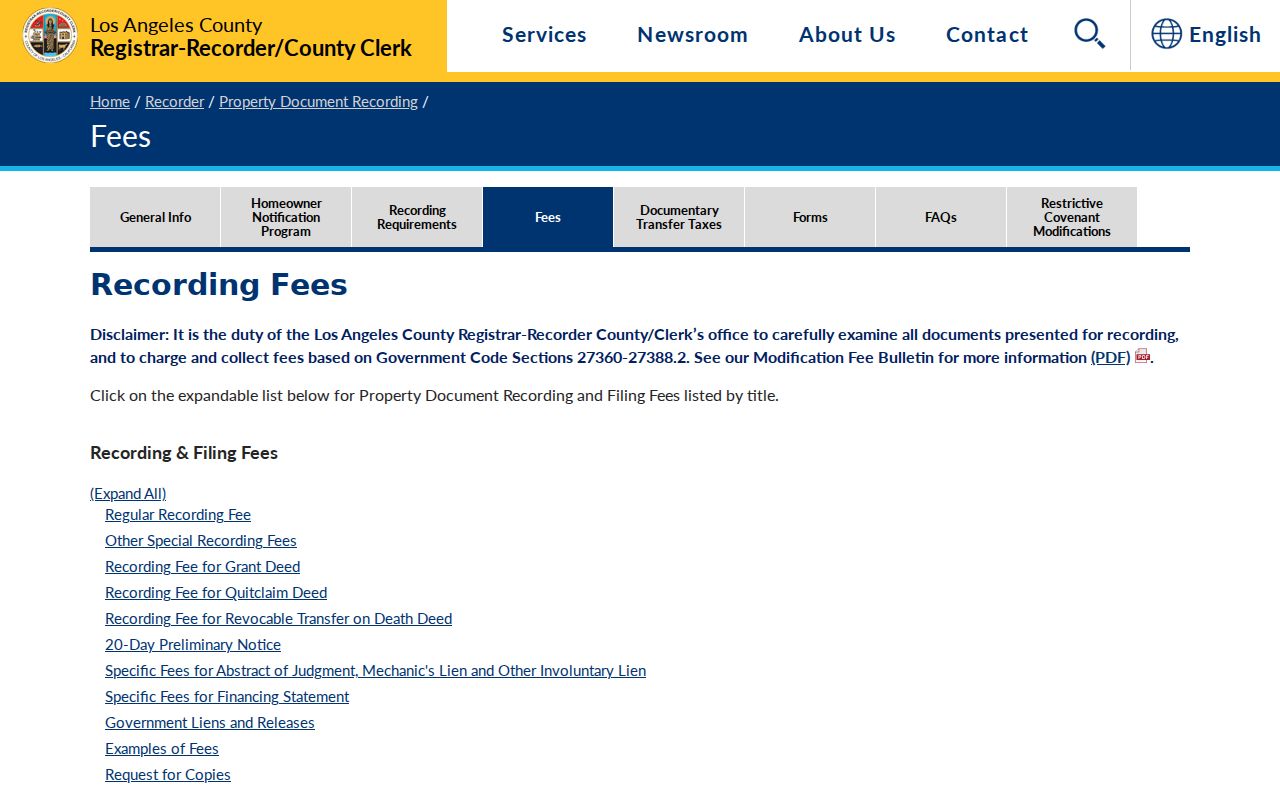
The fee image highlights the value of a known document number.
Lawful Covina House History
House history is strongest when it distinguishes owners, listed subscribers, census households, applicants, heirs, and people who never entered an indexed record. Previous residents who boarded, shared a home, or used a protected address may not appear in deeds or assessment rolls. A public record can contain an error or a redaction, so the originating custodian remains the authority for correction.
Use names and addresses for family history, genealogy, estate research, reconnecting with classmates, or understanding a property's civic and physical history. Do not publish a living person's protected address, assemble a private household roster, or use a record to stalk, harass, or track someone. California confidentiality rules, sealed files, and Safe at Home protections can remove details from otherwise useful sources.
Lawful house history. Covina previous-resident research is appropriate for personal, genealogical, and property-history questions. Verify each clue with its custodian and stop when the record would expose or endanger a living person.